SEPTEMBER 16, 2022 ; 4.30 PM – 6 PM ET; LUCE HALL, ROOM 202, NEW HAVEN
Event Description: Join Y-RISE and the South Asian Studies Council as we host the launch of Scott MacMillan’s book Hope Over Fate: Fazle Hasan Abed and the Science of Ending Global Poverty tracing the evolution of BRAC, one of the world’s largest NGOs. The book launch will be followed by a moderated panel discussion, during which BRAC and Y-RISE will announce a new partnership : a “scaling accelerator” to pair BRAC’s world-class implementation capacity with Y-RISE style rigorous research on scaling complexities. Please also join us for a reception afterwards from 6 – 7pm in the Luce Hall tent.
Event recording here
Panelists:
Asif Saleh (Executive Director, BRAC)
Tamara Abed (Managing Director, BRAC Enterprises)
Scott MacMillan (Author and Director of Learning and Innovation, BRAC USA)
Mushfiq Mobarak (Professor of Economics, Yale University)
Heidi McAnnally-Linz (Deputy Director, MacMillan Center)
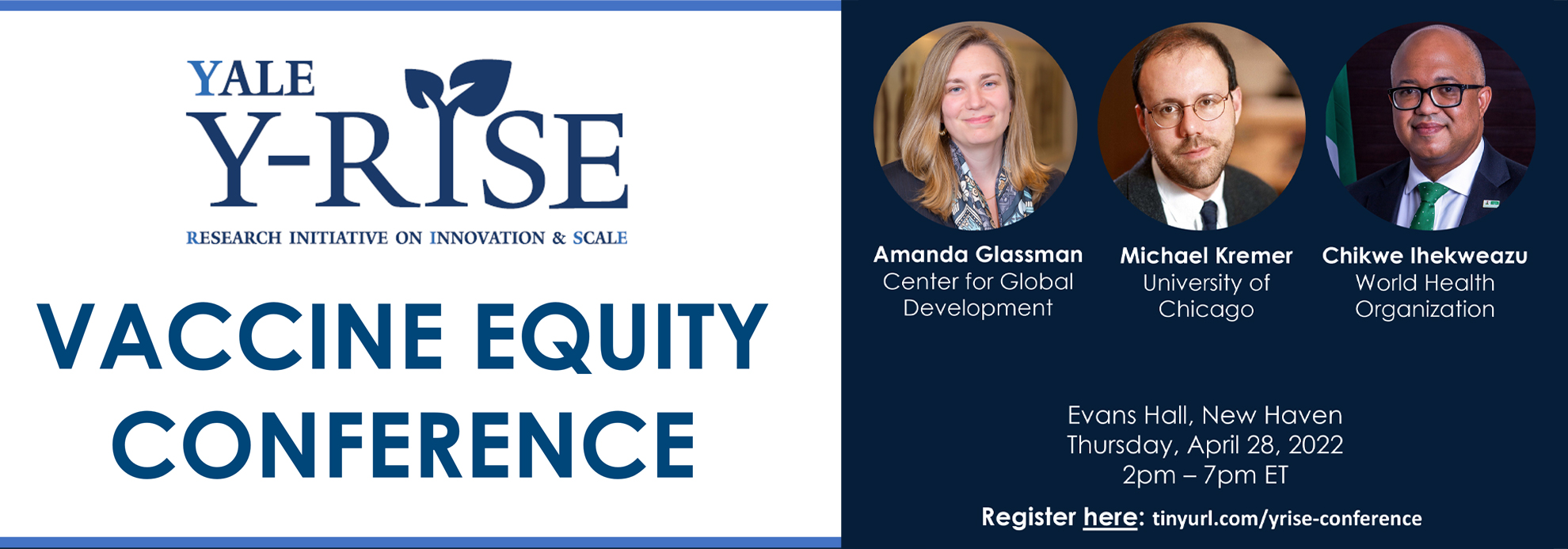
APRIL 28, 2022 ; 2PM – 7PM ET; EVANS HALL, NEW HAVEN
Event Description: This Y-RISE conference aims to bring together representatives from academia, government, civil society, and philanthropy to share insights on what has been done so far and discuss future action around vaccine equity. Sessions will focus on vaccine inequity in the developing world; economic, public health and policy measures to reduce inequity; last mile delivery of vaccines in the developing world and scaling up programs to deliver masks and vaccines.
Event Recording here.
Panelists:
Michael Kremer(Nobel Laureate, Professor of Economics, University of Chicago)
Saad Omer (Director, Yale Institute of Global Health)
Amanda Glassman (Executive Vice President, Center for Global Development)
Mushfiq Mobarak (Professor of Economics, Yale University)
Dr. Desmond Kangbai (Director -EPI Program, Min. of Health & Sanitation, Sierra Leone)
Neela Saldanha (Executive Director, Y-RISE)
Jason Abaluck (Associate Professor of Economics, Yale School of Management)
Asif Saleh (Executive Director, BRAC)
Laura Kwong (Assistant Professor, University of California Berkeley)
Dr. Ashley Styczynski ( International Infection Control Program, CDC)
Heidi McAnnally-Linz (Deputy Director, MacMillan Center)
Hakeem Belo-Osagie (Nigerian entrepreneur; Lecturer, Harvard Business School)
Chikwe Ihekweazu (Assistant Director General, WHO, Hub for Pandemic & Epidemic Intelligence)
Gregg Gonsalves (Associate Professor, Yale School of Public Health)
Download Program here
Watch the full event here.
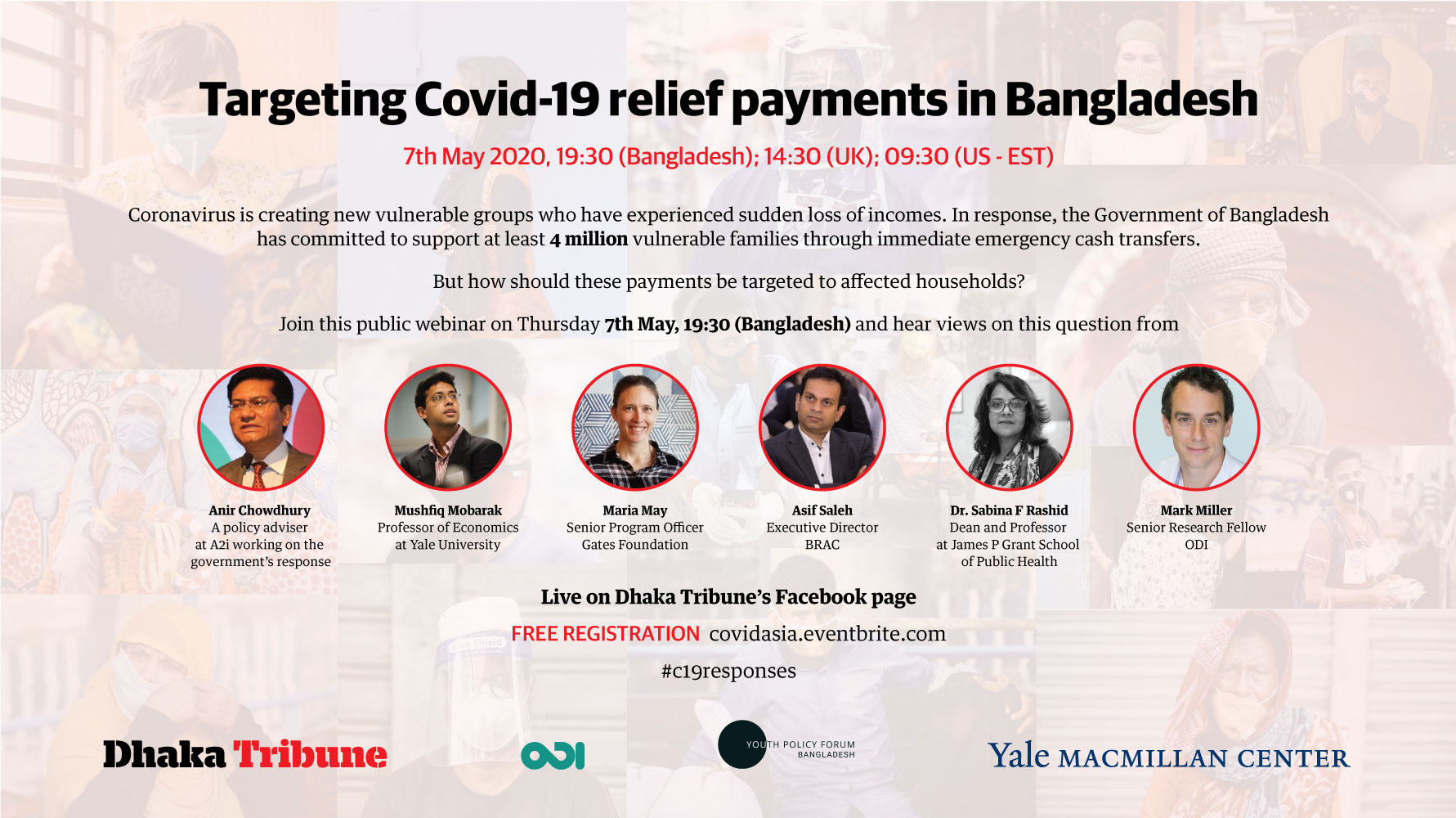
Around the world, cash transfers are increasingly been adopted as a way to support incomes of the poorest citizens. However, the economic disruptions and social distancing policies arising from the coronavirus is creating new vulnerable groups in need of immediate cash support. This includes informal workers, day laborers, and others whose ability to get by has been challenged by the sudden loss of income. A recent survey from Bangladesh (PDF) found that 63% of low-income households reported complete loss of income once social distancing policies were implemented. In response, the government of Bangladesh has committed to support at least 4 million vulnerable families through immediate emergency cash transfers.How though can the government identify the households who need it the most? These households are not found in traditional social safety net program registries, lack no formal documents about their occupation or business, and are paid in cash, making it hard to verify them income. Ensuring that they have access to emergency cash transfers poses an enormous, urgent challenge to governments looking to support those who need it the most.
This webinar will explore:
- How should the government navigate tensions between the speed of response, equity concerns and the effectiveness of targeting?
- How might governments work with different partners (e.g. academics, civil society, telecom operators) to support more effective targeting?
- Given that Bangladesh has a relatively large gender gap in mobile phone ownership, what can the government do to avoid potential exclusion in targeting and access to cash transfers?
Panelists:
Anir Chowdhury (Policy Advisor, A2i – Government of Bangladesh)
Mushfiq Mobarak (Professor of Economics, Yale University)
Sabina Rashid (Dean and Professor at James P Grant School of Public Health)
Asif Saleh (Executive Director, BRAC)
Moderators:
Maria May (Senior Program Officer, Bill and Melinda Gates Foundation)
Mark Miller (Senior Research Fellow, ODI)
Watch the full event here.
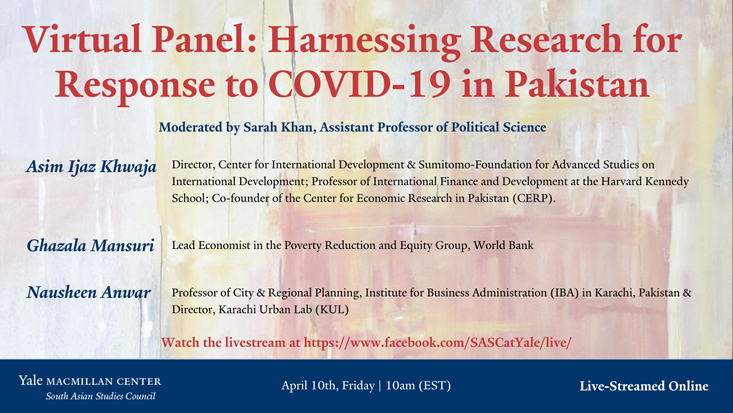
The South Asian Studies Council in collaboration with Y-RISE hosted a virtual panel about harnessing research for COVID-19 response in Pakistan on Friday, April 10.
Panelists:
Asim Ijaz Khwaja is the Director of the Center for International Development and the Sumitomo-Foundation for Advanced Studies on International Development Professor of International Finance and Development at the Harvard Kennedy School, and co-founder of the Center for Economic Research in Pakistan (CERP). His areas of interest include economic development, finance, education, political economy, institutions, and contract theory/mechanism design. His research combines extensive fieldwork, rigorous empirical analysis, and microeconomic theory to answer questions that are motivated by and engage with policy.
Ghazala Mansuri is a lead economist in the Poverty Reduction and Equity Group of the World Bank. Her research spans four broad areas: rural land, labor and credit markets, the economics of household behavior, and the political economy of participatory development and institutional and governance reforms for development. Her research on the political economy of local development includes a number of evaluations of participatory development programs. Dr. Mansuri has published extensively in leading journals in economics and development. She holds a Ph.D. in economics from Boston University.
Nausheen Anwar, Professor City & Regional Planning, Director Karachi Urban Lab (KUL), Department of Social Sciences & Liberal Arts, IBA, Karachi, Pakistan, focuses on the role policy-making and planning processes play in sustaining urban and regional inequality in cities in the Global South. She has written a book “Infrastructure Redux: Crisis, Progress in Industrial Pakistan & Beyond” and is the recipient of several research grants from Harvard University, IDRC, DFID, AHRC/ESRC, NUS. Her latest work takes a look at new-fangled regimes of infrastructure planning, urban renewal land acquisition/development, and attended regional-urban transformations that involve enclosures, displacements, evictions, protests, and pathways of redress in urban Pakistan.
The panel will be moderated by Sarah Khan, Assistant Professor of Political Science, Yale University.